
Shifting Focus for the Holidays
The UCAT Debrief - Week 5
Hi everyone,
We are now entering one of the most important periods of the UCAT year.
The Term 1 holidays are where preparation starts to separate. Up until now, most of the focus has been on learning techniques, understanding question types, identifying common traps, and becoming more familiar with how the UCAT actually works.
From this point onwards, the focus shifts.
It is no longer just about knowing what the right strategy is.
It is about actually being able to apply that strategy under pressure.
That is the difference between conscious incompetence and conscious competence — and that transition should be the major goal for students over the next two weeks and throughout the rest of Term 2.
Over the last few months, most of the work we have done has been about learning techniques, understanding question types, identifying traps, and becoming more familiar with how the UCAT actually works.
That early phase is important because when students first begin UCAT preparation, they are usually in a stage called unconscious incompetence.
This simply means you do not yet know what you do not know.
At the start, most students look at the UCAT and think things like “VR just looks like reading,” “DM is common sense,” “QR is just maths,” or “I’ll naturally get faster with practice.” The issue is that students have not yet done enough questions to understand how specific the skills are, how tight the timings are, or how different UCAT thinking is from normal school thinking.
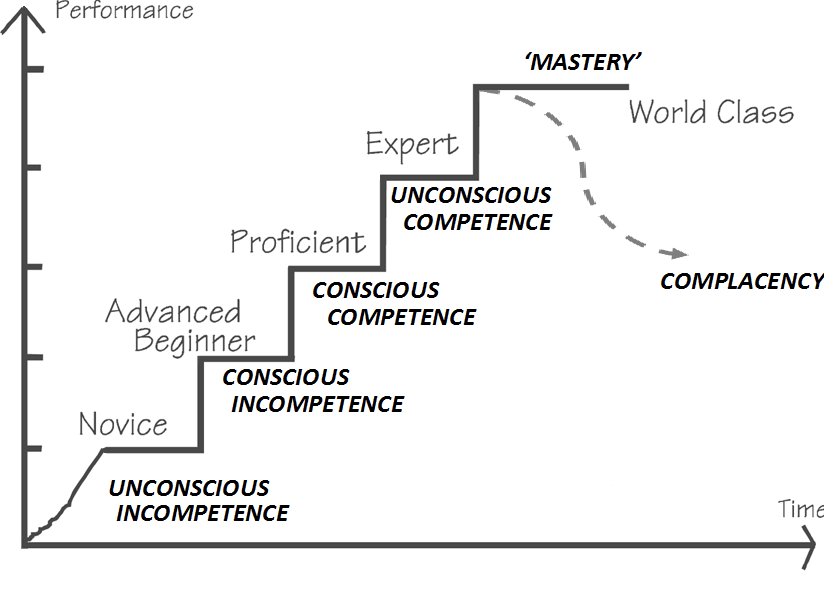
The Four Stages of Competence
Why The First Few Months Mattered
That is why the first few months of the course were so important.
We were taking you from unconscious incompetence into conscious incompetence.
You are no longer making mistakes without understanding why. You are now far more aware of what good performance looks like and where your own weaknesses sit.
You know that in VR you should not reread whole passages.
You know that in QR you should not overcommit to one difficult calculation.
You know that in DM you need to slow down and structure the information properly.
That awareness is a good thing.
But it is also the stage that many students find the most frustrating.
This stage is called conscious incompetence.
Conscious incompetence is when you know what you should be doing, but you cannot yet do it consistently under pressure.
This is where students start saying things like:
“I know I should skip difficult questions, but I still stay too long.”
“I know why I got that wrong after seeing the explanation, but I still make the same mistake next time.”
“I understand the strategy, but I cannot apply it fast enough in a timed set.”
“I know what I am doing wrong, but I still cannot seem to stop doing it.”
That is the exact stage most students are now in.
And while it feels uncomfortable, it is actually a very positive sign.
Because before you can improve a weakness, you have to see it clearly.
The problem is that many students stay in conscious incompetence for too long.
They keep doing questions, but they do not tighten the feedback loop between their mistakes and their future practice.
They keep recognising errors, but they do not actively train themselves out of them.
Why The Term 1 Holidays Matter So Much
That is why the Term 1 holidays matter so much.
The next two weeks are not just another study block.
They are probably the single most important momentum-building period of the year.
Why?
Because this is the period where students should be moving from conscious incompetence into conscious competence.
Conscious competence is when you can finally start doing the right thing in real time.
You still need to think about it. You still need to actively remind yourself. But you can now execute the right strategy while you are in the middle of the question, not just afterwards when you are reviewing.
For example:
In VR, you start actively skipping difficult passages instead of getting stuck.
In QR, you start recognising when a question is not worth the time.
In DM, you begin slowing yourself down and structuring the information properly before rushing into the answer.
What Conscious Competence Actually Looks Like
This is where students start feeling more in control.
Mistakes still happen, but they no longer feel random.
You can explain why they happened.
You can identify patterns.
You can feel yourself catching errors earlier.
That is what progress looks like.
The reason the Term 1 holidays are so important is because they give you the uninterrupted volume of practice needed to create that shift.
Key Updates - Important Dates
For most Australian States, the Term 1 holidays run from approximately Saturday 4 April until Sunday 19 April.
That gives you roughly two weeks of uninterrupted preparation before Term 2 begins.
Those two weeks are not just “extra study time.” They are the best opportunity of the year to create real momentum before school becomes busy again with SACs, assignments, and extracurricular commitments.
Students who use these holidays properly often carry that momentum through the entirety of Term 2.
Students who waste them often spend the rest of Term 2 trying to catch up.
During school term, it is very easy to stay in a cycle of doing one or two sets per week, attending class, and feeling like you are staying afloat. But the holidays are where students finally get enough repetition, enough review, and enough exposure to start embedding the correct habits.
This is where the real momentum is built.
And momentum matters because once you begin building it, improvement becomes easier.
You become faster.
You become more confident.
You start recognising question types more quickly.
You stop making some of the same mistakes.
The feedback loop becomes positive.
What Happens If You Do Not Build Momentum
But if students do not build the right momentum during the Term 1 holidays, they often struggle to make major jumps later.
The issue is not that they cannot improve.
The issue is that they never build enough stimulus.
If you only do a small amount of UCAT each week, you might maintain your current level, but you are unlikely to improve significantly.
Improvement requires repeated exposure.
It requires enough volume for your brain to start recognising patterns automatically.
It requires enough mistakes for you to start understanding what keeps going wrong.
And it requires enough review for you to start changing your habits in real time.
That is why students who use the Term 1 holidays well often improve dramatically across Term 2.
They enter the term with momentum.
They already know what their weaknesses are.
They already have systems for fixing them.
They are no longer spending all of their energy trying to understand what they are doing wrong. They are now spending their energy actively correcting it.
That is the key transition.
Over the next two weeks and through the rest of Term 2, your priority is not perfection.
Your priority is moving from knowing what the right strategy is to being able to apply it consistently.
That is conscious competence.
You do not need every skill to feel automatic yet.
That comes later.
Looking Ahead
The final stage, unconscious competence, is when the correct behaviours become automatic. That is when you instinctively skip the right VR passage, estimate the right QR answer, recognise the right AR pattern, or structure the right DM question without consciously thinking about it.
That will be a much bigger focus heading into the Term 2 holidays.
For now, the goal is simpler.
Build enough repetition, enough momentum, and enough self-awareness that the correct strategies stop feeling foreign and start feeling familiar.
Because that is where real confidence starts to come from.
Real confidence is not built by hoping that things will click one day.
It is built by repeating the right behaviours often enough that they start to feel normal.
Next week, we’ll talk about the volume vs quality of practice.
See you then.
Lavya
Head of UCAT
