
It's Not Too Late to Build Good UCAT Habits
Hi everyone,
Before we get into today’s idea, a quick reminder that
UCAT bookings opened on 3 March.
If you have not yet booked your test, you should be looking at available dates soon so you are not forced into a late sitting. Early booking gives you more control over when you test.
If you’re unsure how to book, or are confused about the process, please reply to this email and I’m happy to help you through it.
There are also a few other important milestones coming up over the next few months:
Key UCAT Dates
UCAT bookings open: 3 March
Access arrangements / concession applications: 15 May
Final UCAT booking deadline: 15 May
UCAT testing period: 01 July - 05 August
We’ll talk more about preparation timelines in later newsletters, but the most important thing right now is simply that you know your testing window and begin structuring your preparation around it.
From Feedback Loops to Habits
Last week we zoomed out and talked about feedback loops — the invisible systems that quietly reinforce either progress or stagnation. Effort leads to improvement, improvement leads to confidence, confidence makes effort easier, and the cycle strengthens itself.
This week we’re going one level deeper.
Underneath those feedback loops sit something even more fundamental: habits.
A lot of students assume habits are built through discipline or sudden bursts of motivation. In reality, habits are rarely formed through intensity. They are formed through repetition inside a stable system.
Every time you repeat a behaviour in the same context, your brain strengthens a small neural pathway associated with that behaviour. Over time, that pathway becomes easier to activate. What once felt deliberate begins to feel automatic.
Which is why the quote for this week captures it so well:
“First we make our habits, then our habits make us.”
— John Dryden
The Habit Loop
Psychologists often describe habits using something called the habit loop, which consists of three parts:
A cue that triggers the behaviour
The behaviour itself
A reward that reinforces the behaviour
Over time, your brain begins to anticipate the reward whenever the cue appears.
For example, a student might sit down at their desk after dinner (cue), complete a short UCAT question set (behaviour), and feel a small sense of progress (reward). Eventually the cue itself begins to trigger the behaviour almost automatically.
But the opposite can happen too.
If the cue becomes associated with frustration or anxiety, your brain learns to avoid it. Sitting down to practise UCAT might trigger stress rather than progress. Avoidance then becomes the new habit.
This is why simply telling yourself to “try harder” rarely works. You are not just fighting effort in the moment — you are fighting a behavioural system that has already been reinforced many times.
How Long Do Habits Actually Take to Form?
You’ve probably heard that habits take 21 days to form.
That’s mostly a myth.
Research from University College London led by Phillippa Lally found that, on average, behaviours take about 66 days to become automatic, although the timeline varies depending on how complex the behaviour is.
The important point isn’t the exact number of days. The important point is that habits form through repetition in the same context. Consistency matters more than bursts of motivation.
Breaking habits works in a similar way. You don’t erase a habit overnight. Instead, you gradually weaken the cue-behaviour association by interrupting the loop repeatedly. Each interruption weakens the old pathway slightly while strengthening a new one.
Why Environment Matters More Than Willpower
One of the most powerful ideas from Atomic Habits is that behaviour change often starts with changing the environment, not changing yourself.
Most people believe discipline lives entirely inside their mind.
In reality, discipline often lives in the room around you.
Your environment constantly nudges your behaviour in one direction or another.
If your desk is cluttered, your phone is visible, and your UCAT materials are buried somewhere in your bag, your environment is quietly encouraging avoidance.
If your UCAT notebook is open, your laptop is already on the question bank, and your phone is in another room, your environment is nudging you toward action.
The goal isn’t to rely on motivation.
The goal is to design an environment where the easiest behaviour is the one you want to perform.
I’ll include a photo below from when I was in Year 12.
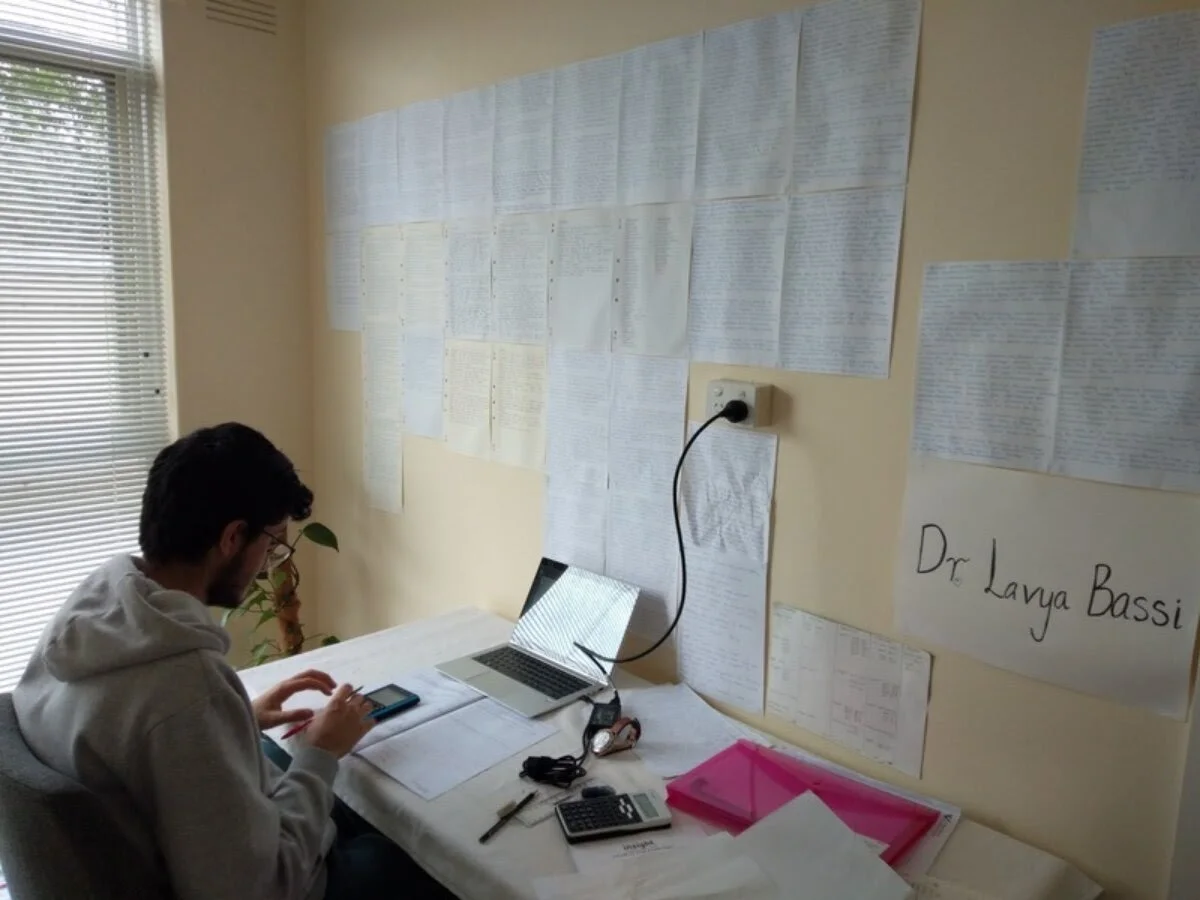
You’ll notice something about it: the desk is incredibly simple. No clutter, no distractions — just the essentials.
But the most important thing on that desk wasn’t the laptop or the books.
It was a large A3 piece of paper taped above the desk that simply said:
Dr. Lavya Bassi
At the time that obviously wasn’t true yet — but it was deliberate.
That sign acted as a cue.
Every time I sat down at the desk and saw it, it reminded me of the long-term goal I was working toward. The cue triggered the behaviour: sitting down and doing the work that moved me closer to that identity.
And over time, the behaviour itself produced the reward — progress, improvement, confidence.
Cue → Behaviour → Reward.
The environment made the habit easier to sustain.
It wasn’t some dramatic motivational trick. It was just a small environmental design choice that repeatedly nudged me toward the behaviour I wanted.
Designing Habits Intentionally
James Clear summarises habit design with four simple principles:
To build a good habit, make it:
Obvious – create clear cues that trigger the behaviour
Easy – reduce friction between intention and action
Attractive – associate the habit with positive outcomes
Satisfying – reinforce it with small rewards
To break a bad habit, reverse the process:
Make the cue invisible
Make the behaviour difficult
Make it unattractive
Make it unsatisfying
For example, if social media constantly interrupts your study sessions, moving your phone out of reach — or even into another room — removes the cue and increases the friction required to access the distraction.
Small environmental changes often produce surprisingly large behavioural effects.
The Bigger Picture
Habits compound over time in exactly the same way practice does.
The students who perform best in the UCAT are rarely the ones who feel motivated every day. They are the ones who have quietly engineered systems that keep pulling them forward even when motivation fades.
They design cues that trigger productive behaviour.
They reduce friction around practice.
They reinforce positive feedback loops.
Preparation stops being something you have to force yourself into.
It simply becomes something you do.
The goal isn’t to fight your habits.
The goal is to design them.
Next week, we’ll talk about Behavioural Friction and things that could still be holding you back even after applying the above.
See you then.
Lavya
Head of UCAT
